History

| Hoy Tung Gee |
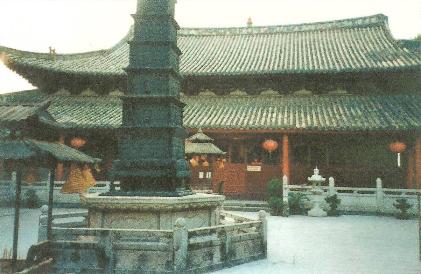
Hoy Tung Monastery was built during the reign of K’ang-hsi (1661-1722), the second emperor of
the Ch’ing Dynasty (aka Manchu Dynasty) in China’s history. It was constructed next to the Pearl
River on a location called Wan Sung Ling from 1666-1672.
During the early years of the Ch’ing Dynasty, the southern part of China was occupied and controlled
by Wu San Kuei, Shang K’e Hsi and Keng Ching Chung. Wu and Shang were former generals of
the Ming Dynasty (1368-1644) and Keng was a descendant of a former Ming general. These three
had assisted the Manchu leaders and their armies in the overthrow of the Ming Empire in 1644.
After the Manchus became China’s new rulers, they established the Ch’ing Dynasty and rewarded
Wu, Shang, and Keng by designating each a title comparable to governor and granting each a feudal
state in Southern China. Wu San Kuei (1612-1678), Shang K’e Hsi (1604-1676), and Keng Ching
Chung (?-1682) were granted Yunan Province, Kwongtung Province and Fukien Province
respectively, with each having his own army.
Saddened by the destruction and termination of the old regime, Ming loyalists in Kwongtung Province
made various attempts and took desperate measures to remove the Manchu rulers and revive the
Ming Empire. The two warlords Shang K’e Hsi and Keng Ching Chung ordered their armies into
Kwongtung Province to suppress the uprising. A ruthless massacre ensued, filling the air with an aura
of pain and suffering.
The two warlords realized that the killings were overly excessive and ordered the armies to stand
down. Kind and innocent people were murdered arbitrarily and indiscriminately. The souls of those
who were murdered would not rest; their doleful cries were heard late into the nights. Apparitions
emerged from every shadow and faded with the cool night breeze. The warlords understood that
these souls must be released from suffering, otherwise they would not disappear. The services of
monks and nuns were needed to pray for the suffering souls.
the Ch’ing Dynasty (aka Manchu Dynasty) in China’s history. It was constructed next to the Pearl
River on a location called Wan Sung Ling from 1666-1672.
During the early years of the Ch’ing Dynasty, the southern part of China was occupied and controlled
by Wu San Kuei, Shang K’e Hsi and Keng Ching Chung. Wu and Shang were former generals of
the Ming Dynasty (1368-1644) and Keng was a descendant of a former Ming general. These three
had assisted the Manchu leaders and their armies in the overthrow of the Ming Empire in 1644.
After the Manchus became China’s new rulers, they established the Ch’ing Dynasty and rewarded
Wu, Shang, and Keng by designating each a title comparable to governor and granting each a feudal
state in Southern China. Wu San Kuei (1612-1678), Shang K’e Hsi (1604-1676), and Keng Ching
Chung (?-1682) were granted Yunan Province, Kwongtung Province and Fukien Province
respectively, with each having his own army.
Saddened by the destruction and termination of the old regime, Ming loyalists in Kwongtung Province
made various attempts and took desperate measures to remove the Manchu rulers and revive the
Ming Empire. The two warlords Shang K’e Hsi and Keng Ching Chung ordered their armies into
Kwongtung Province to suppress the uprising. A ruthless massacre ensued, filling the air with an aura
of pain and suffering.
The two warlords realized that the killings were overly excessive and ordered the armies to stand
down. Kind and innocent people were murdered arbitrarily and indiscriminately. The souls of those
who were murdered would not rest; their doleful cries were heard late into the nights. Apparitions
emerged from every shadow and faded with the cool night breeze. The warlords understood that
these souls must be released from suffering, otherwise they would not disappear. The services of
monks and nuns were needed to pray for the suffering souls.
 |  |  |  |  |  |  |